
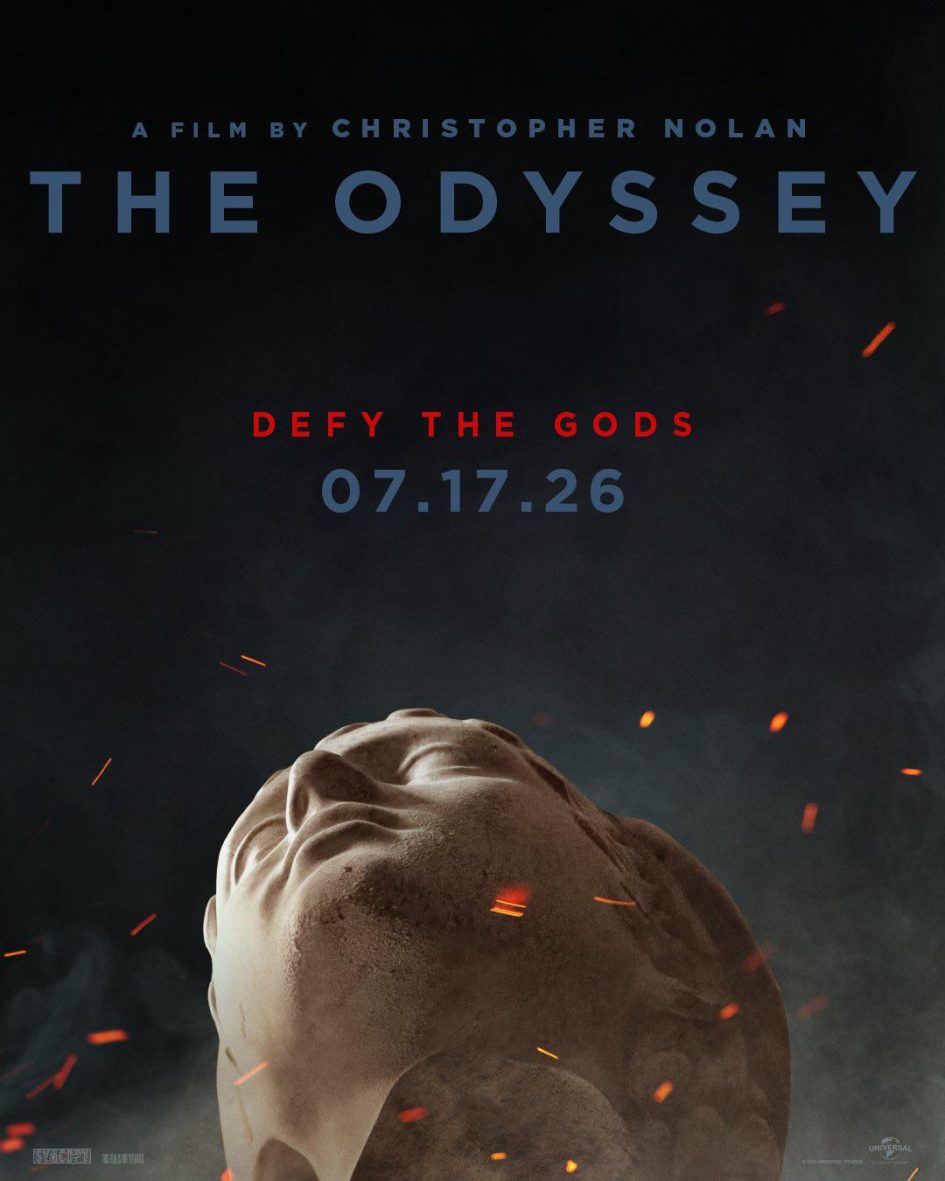
Nolan is no stranger to pushing the limits of cinema. From his earliest features, he was already looking at movies through a different lens than most. When Memento was released, it opened audiences’ eyes to how innovative storytelling through film could be. That sense only grew as he explored space travel, dreamwalking, and entropy reversal, to name a few. Over time, Nolan became a household name, and each new project felt like a cultural event. Following the success of Oppenheimer, which took home seven Academy Awards in 2024, anticipation for Nolan’s next project was through the roof. How do you follow up one of the best films of the decade? As far as storytelling goes, there is no other piece of literature that has captivated humanity throughout history quite like The Odyssey.
As with any adaptation, the first place to look is the source material, as the changes made can often reveal how a director interpreted the story and what they’re ultimately trying to accomplish. Anyone who’s read The Odyssey knows that a faithful adaptation would not be possible without an unreasonable runtime; sacrifices must be made. Nolan’s screenplay makes numerous changes, from combining scenes to trimming conversations and even adding new material, but it never feels like a different story. The intent behind the changes was never to reinvent Homer’s epic, but rather to tell that story in the most effective way possible. That philosophy becomes clearer after hearing Nolan’s response in a recent interview with 60 Minutes. When asked whether he considers himself the most important person on set, he replied, “I think of myself as the representative of the audience on set. That’s my north star.” After watching The Odyssey, it’s easy to see the approach he was going for. These changes were never motivated by ego or an agenda, but rather by a desire to make this story resonate as powerfully as possible.
With less time to explore every conversation and relationship from the original poem, much of the emotional storytelling falls on the performances, and this stacked cast was up to the challenge. At the helm is Matt Damon as Odysseus, who gives one of his better performances. While Damon is at his strongest portraying Odysseus’ quiet burden, it’s Anne Hathaway as Penelope who steals the spotlight. A powerhouse of a performance. Every scene she’s in, she stands a head taller than the rest of the characters, commanding attention even in the quieter moments. Together, Damon and Hathaway carry the emotional weight of this story, culminating in a third act that was brilliant from them both.
Around them is an ensemble of great performances, but none more entertaining than the dynamic between Tom Holland’s Telemachus and Robert Pattinson’s Antinous. Every time these two are on screen together, it’s entertaining. Pattinson is radiating hatred and villainy from start to finish, and the clash with Holland’s innocent but sincere performance was a treat to watch. For all the discussion around this cast before release, but after watching the film, it’s hard to imagine anyone else in these roles.
The Odyssey is definitely not the first time Nolan has told a story in non-chronological order, and his years of experience are on full display here. The films opening act has an enormous amount of heavy lifting to get done, introducing its characters and their motivations while also brining the audience up to speed on the events of The Iliad. Nolan and editor Jennifer Lame do their best to keep the story moving by utilizing the same brisk editing that made Oppenheimer so compelling, and for the most part, keep this story from dragging. An epic on the scale of The Odyssey is bound to feel dense, but the film finds a beautiful balance between the epic grand adventures of Odysseus and the calm meditative moments. Walking out of the theater, I felt like I’d experienced a years-long journey, but during the runtime there was never a moment that overstayed its welcome. A major part of this pacing was the desire to see each stunning frame just a little longer.
A major part of the great pacing was the desire to see each frame just a little longer. If there’s a director you’d expect to make the first movie shot fully in IMAX, it’s Christopher Nolan. But does this serve the story, or is it just a marketing hook? After seeing the film, there’s nothing gimmicky about it. Each frame is breathtaking. A screen so large it demands you turn your head to take it all in, making the world feel endless. Director of Photography Hoyte Van Hoytema is undoubtedly one of the best working today, but his ability to compose these massive 70mm frames is unrivaled. Rather than bringing Iceland, Italy, or the other gorgeous set locations to the audience, he frames each shot to bring the audience there instead. Nothing felt artificial, and a major contributor to that was the use of practical effects.
Nolan has long been known for doing as much “in camera” as possible. One of the biggest questions was how Nolan would approach this world of gods, magic, and monsters from a practical standpoint. His solution was pretty clever. First, there’s the shot composition, where Nolan employs a classic horror trick: people are more scared of what they can’t see. Using this, he’s able to build tension before anything supernatural is shown. When monsters and magic are revealed, they aren’t the most fantastical versions of these creatures but rather are designed around the tone and world this film has established. That’s not to say that these practical effects are boring, though. There are still many moments of spectacle, with a particularly horrific sequence in the middle standing out. Looking good is only half the battle, to truly sell the illusion, the audience needs more of this world than just its visuals.
Ludwig Göransson, need I say more? The score might be the most surprising part about The Odyssey, and it provides one of the clearest insights into Nolan’s vision for this project. Traditionally, when audiences think of gods, magic, and heroes, they hear sweeping orchestras, booming percussion, and powerful brass. Göransson takes a different approach here, opting instead to build the score around instrumentation from the time period. This includes harps, lyres, aulos (a reed instrument), and brass percussion. The result is a score that is one of a kind, making The Odyssey feel less like a Hollywood superhero movie and more like a story passed down around the campfire. Göransson still gets a few opportunities to let to score shine through, and he takes full advantage of each one.
Looking at the film as a whole, the immersive visuals, the reserved score, the changes from the source material, and the performances that bring these characters to life, it becomes clear what fascinated Nolan about The Odyssey. Of course, the massive scale and scope gave Nolan an excuse to fulfill his dream of making a movie in full IMAX, but I think it’s the smaller, intimate moments that truly drew him in. At its core, The Odyssey is a story about humanity. Gods and monsters play second fiddle to the choices made by one man. Just as Oppenheimer was never about the bomb going off, The Odyssey was never about the monsters and myths. Beneath all of that is a story about a man forced to confront the weight of his own decision, a simple deception that would set off a chain reaction he could have never seen coming. Sound familiar?
Through Odysseus, Nolan is able to explore these ideas more. A man haunted by the belief that his own intelligence and ability to outmaneuver could protect him from consequence. This intelligence ultimately became the source of his guilt, pain, and shame. A warning that being clever is not the same thing as being wise. These themes are echoed constantly throughout, building to a third act that delivers on everything it’s promised, a showcase of some of the best filmmaking I’ve experienced. The Odyssey is a massive story, and at times can feel too big for its own good, but Nolan understands the power of this story was never in its scale, but rather in the humanity at its center. For thousands of years, we have returned to this story because it reflects something timeless about ourselves. Now, as another generation searches for answers in Odysseus’ journey, there could not be a more fitting guide than Christopher Nolan.
4.5/5 Stars