
Musk
October 8, 2026: Ukrainian drone strikes hit the Yandex data center in Sasovo, Russia. Network monitoring reports indicated an immediate drop in bot activity on the internet. Some reports put it at close to a 45% decrease in activity, including traffic on X.com.
October 13/14, 2026: SpaceX shuts down Starlink access terminals moving at speeds over 100 mph, effectively disabling a planned mass drone strike by Ukrainian forces against their Russian occupiers.
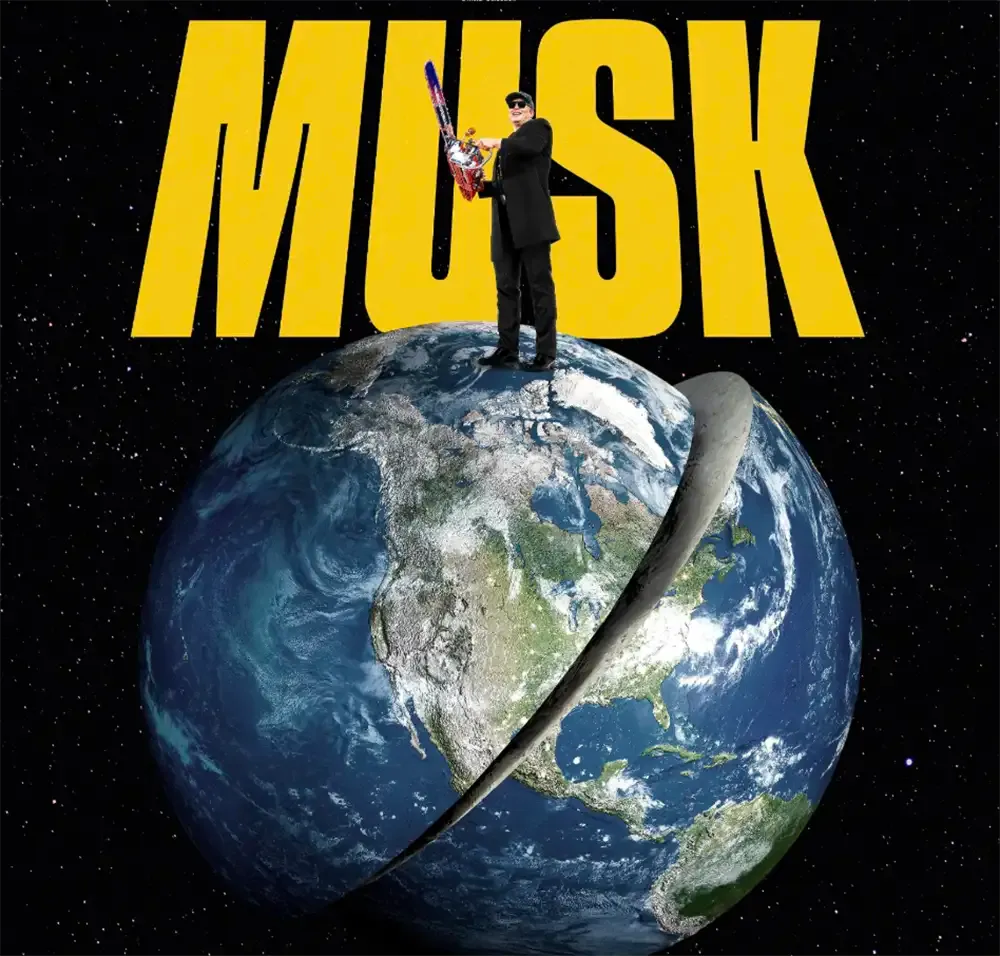
October 15, 2026: “Musk,” the documentary, premieres across the United States. Coincidence? If you watched this documentary, you may think not.
The irony was not lost on this viewer when, with these pieces in mind, I sat down to watch this film and, halfway through, was hit with a ten-minute countdown for an intermission.
I needed it.
“Musk” is a documentary about the polarizing but eccentric former trillionaire, Elon Musk. Director Alex Gibney, the Oscar winner behind “Enron: The Smartest Guys in the Room,” spent about four years on this one, and it shows. The runtime lands somewhere around three hours and forty-five minutes, intermission included. When asked by Gibney to participate, Musk declined, and Gibney moved on.
Well, moved on is not quite accurate. Musk is in this movie constantly. Gibney builds him out of old interviews, archival footage, and an AI-driven, bobblehead-looking avatar that speaks words Musk really said, just not to Gibney. It is a clever workaround, and a little eerie. The proportions of the character were way off, but it sat in a chair most of the time, and to be honest, that was likely done on purpose. It harkens back to Matt Damon’s marionette character in “Team America: World Police,” with no strings.
The thesis is not subtle. Gibney sees Musk as a modern confidence man, and he borrows Musk’s own fondness for video games and simulations to make the point. A few scenes play like a first-person shooter, with Musk as the player and Twitter employees and federal workers as the targets.
The people doing the non-AI-avatar talking are the ones who got close. Justine Musk, his first wife, is here. So is his father, Errol, which I did not see coming. Ashley St. Clair, who shares a child with Musk, is another. Tesla co-founder Martin Eberhard walks the viewer through the fight over who gets to call himself a founder. (Surprisingly, anyone can claim to be a founder of anything.) Geoffrey Hinton, Reid Hoffman, Kara Swisher, and Samantha Power round out the roster. Former partners in life and business, along with journalists who spent decades covering Musk’s rise, appeared en masse in the film. For some reason, people wanted to participate in what Elon himself called a “hit piece” in a post on Twitter back in 2023, before the film was anywhere near complete. Yet nothing about this documentary or its participants felt like a story being told because someone has an axe to grind. Most of the stories were backed by Musk’s own words, whether in tweets sent or in interviews. One has to wonder if the man even knows the meaning of the word “regret.”
The story starts in South Africa, runs through the dot-com years, and works its way through Tesla, SpaceX, Twitter, and eventually Washington. The Tesla self-driving section stands out because, to this day, more than 12 years later, true autonomous self-driving from Autopilot still does not exist.
When the film turns to Musk’s time in Washington and his involvement with DOGE, this is where Gibney seems most comfortable, likely because the receipts exist in government documents and archives. There is no fear in talking about the failures and what really happened, and it is easily the most hard-hitting piece of the documentary. For me, it was also the most tense and anxiety-inducing stretch. As someone who watched each and every move the DOGE team made live, blasted across the internet and relayed to our mobile devices every day, I began to wonder if I would leave the theater with PTSD from the recent reminders.
The starkest reminder that this documentary ends yesterday came when Gibney started reminding us about Musk’s involvement in the AI movement. From his early involvement with OpenAI, to his creation of xAI, to the merger with SpaceX and X.com to save x.com from going under, and then to the creation of Grok, the xAI-driven LLM that relied heavily on X.com content as a source of “truth” in its data-driven push for free speech. One almost forgets that there was a time when Elon spoke loudly against allowing our AI overlords to run unfettered around the World Wide Web, and across the spider web of technology we carry in our pockets every day.
Is the film fair? That depends on what you expect from it. This is not a balanced portrait, and it never pretends to be. Musk has accused Gibney of making a false film, but he also publicly claimed that Grok called itself MechaHitler for an entire 24-hour period because a seasoned X engineer went rogue. Gibney says it went through serious fact-checking and a legal review, and Musk’s efforts to shut the release down proved fruitless. Discovery will be a lot of fun if Elon decides to pursue legal action.
Is this journalism? I don’t know that Gibney would ever claim that it is, but when you are able to put the evidence on film, projected onto the silver screen, it really makes you think, or in some cases, shiver.
As one theatergoer said during intermission on their way to the concession stand, “I didn’t know this was f#$@ing four hours.” I, too, felt like it was really long. Not in the sense that I was not going to be able to sit in the non-reclining, 25-year-old theater chair for the entire time, but rather in the sense of, “How real is too real?”
This, for me, was too real.
“Musk” has a runtime of 3 hours and 55 minutes. Directed by Alex Gibney, it opens nationwide on October 16, 2026.
Rating: 4.5 out of 5 stars
Editorial Note: When I arrived home, I opened my phone to x.com, and there, overloading my feed, was a video released at 9PM EST of a Tesla flying car. If anything felt like a stunt to overshadow the release of “Musk”, this was it.



Comments
Comments are for subscribers. Free subscription. No payment, ever.
Subscribe free Sign in