
Klara and the Sun
Taika Waititi’s adaptation of Ishiguro’s “Klara and the Sun” is a warm, aching film about love, grief and faith, seen through the eyes of an Artificial Friend

Taika Waititi has made a career out of finding the soft spot where comedy and heartbreak overlap, and with “Klara and the Sun” he has found one of the biggest soft spots of his career. Working from Kazuo Ishiguro’s novel, Waititi and co-writer Dahvi Waller have built an adaptation that respects its source while still sounding like a Waititi film, and the result is one of the more quietly affecting movies I’ve seen this year.
Jenna Ortega plays Klara, an Artificial Friend, or AF, built to keep children from being lonely. She spends her early days in a store window, soaking up the sun and watching the world go by, waiting to be chosen. Ortega is a vision in the role. She plays innocence without ever playing it young, and that is a harder trick than it sounds. Klara is learning and growing with every single day, yet Ortega carries her with a maturity and steadiness that keeps the character from sliding into something childlike. It is a stunning, controlled performance.
Waititi makes a smart choice by putting us behind Klara’s eyes. When she enters a space she has never seen before, her vision breaks down into a blocky, almost 16-bit mosaic while she waits for the world to come into focus. It is a small device, and it does more to put you inside her head than any amount of narration could.
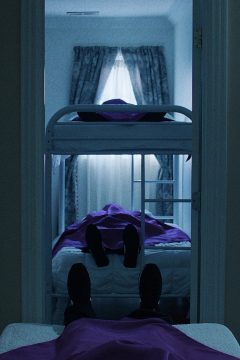
That visual sense runs through the whole film. The palette lives almost entirely in warm oranges, browns and off whites on one side, and cold greys and blacks on the other, with very little in between. There are long shots of wheat fields rolling in the wind that are just plain beautiful. This is a film that knows exactly what it wants to look like, and it commits.
Amy Adams plays Chrissie, the mother of Josie, the sick teenager who brings Klara home. Adams is brilliant, as she nearly always is. Chrissie starts out cold and closed off, a woman already carrying grief, and Adams gently shifts her into someone mourning a loss that hasn’t even happened yet. It is an emotionally strong performance, and it gives the film its spine.
Mia Tharia plays Josie, one of the “lifted” kids, and the connection she builds with Klara is the heart of the story. Tharia holds her own opposite Ortega, and the friendship between the two never feels manufactured.
Then there is Natasha Lyonne as the Manager. Lyonne is one of the few actors who essentially plays the same character every time, the way Ryan Reynolds does, and here that works completely in her favor. She is perfectly cast as the store manager who knows the discontinued B1 models are on their last legs and have no real hope of being chosen. She brings a dry, knowing edge that makes those early store scenes land.
Waititi’s familiar humor is scattered throughout, and it does its job, giving the audience room to breathe between the heavier moments. Michael Giacchino’s score deserves credit too, mostly for its restraint. It supports the film instead of telling you how to feel, and in a story this emotional, that is no small thing.
What stuck with me most is how the film plays with faith. Klara treats the Sun as something close to a god, a source of nourishment and healing she believes can save Josie. The film draws an interesting parallel to anyone who has put their hope entirely in something above them, and then slowly learned that sometimes the path must be built by your own hands rather than waiting on the sky to fix things. Waititi doesn’t preach either way. He lets Klara get there on her own, and the film is better for it.
This movie is beautifully shot, smartly adapted and anchored by two excellent lead performances from Ortega and Adams. Bring tissues.
“Klara and the Sun” is rated PG-13 and runs 1 hour and 56 minutes. The film opens in theaters nationwide on Friday, October 23, 2026.



Comments
Comments are for subscribers. Free subscription. No payment, ever.
Subscribe free Sign in